

 CN
Technical Expertise
Core processes and technical capabilities
Reactions we run well: Friedel-Crafts acylation, bromination, chlorination, Grignard reactions, coupling, asymmetric chiral synthesis (including asymmetric reduction and alkylation), heterocyclic synthesis, reduction, Hofmann rearrangement and other standard reactions.
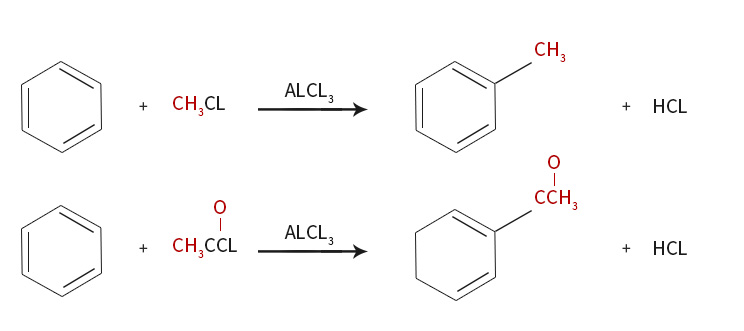
Friedel-Crafts acylation
Friedel-Crafts acylation is a classical route for acylating organic compounds, for example Ar-H + RCOCl → Ar-CO-R + HCl.
Grignard reaction
The Grignard reaction is a classical method for alkylating organic compounds. We often use Grignard reagents to make intermediates and active ingredients for pharmaceutical chemicals. With the dry local air, batch scale runs from 500 kg to several tonnes per kettle.
R-X+Mg→R-MgX
RMgX + H2O → RH + Mg(OH)X
RMgX + ROH → RH + ROMgX
RMgX + RCOOH → RH + RCOOMgX
RMgX + NH3 → RH + NH2MgX
RMgX + RNH2 → RH + RNHMgX
RMgX + RC≡CH → RH + RC≡CMgX
Bromination
Bromination is the classical route to the bromine series.
CH3COOC2H5 + Br2 → BrCH2COOC2H5 + HBr
ClCH2C≡CH + HBr → ClCH2CH2CH2Br
3 RCOOH + PBr3 → 3 RCOBr + HP(O)(OH)2
Acid chloride formation
Sulfonyl chloride, oxalyl chloride, chlorine and hydrogen chloride are commonly used to form acid chlorides. For example:
R-COOH + SOCl2 → R-COCl + SO2 + HCl
R-COOH + PCl3 → R-COCl + HOPCl2
Nitration
Organic compounds are converted into nitro (-NO2) compounds. Nitration of aromatic hydrocarbons is the most important route to aromatic nitro compounds. Nitrating agents include nitric acid and nitryl halides (NOX),
nitronium tetrafluoroborate and others. A mixture of sulfuric acid and nitric acid is the most common.
Ar─H+HNO3→Ar─NO2+H2O
C7H8 + HNO3 → C7H7NO2 + H2O