Introduction: One-component waterborne wood coatings are easy to apply and affordable, but hardness and chemical resistance are often unsatisfactory. How can simple “external crosslinking” raise performance? This report uses measured data to show what aziridine crosslinkers do well, and where they fall short.
One-component waterborne acrylic wood lacquers hold a large market share, but wood cannot be baked at high temperature and can only be crosslinked at room temperature. Many emulsions include “self-crosslinking”, but only to a limited degree.
An external crosslinker is an effective way to raise film performance further. Aziridine compounds react with carboxyl groups in waterborne acrylic resins and form a network at room temperature, which improves the coating.
Structural formula of the aziridine crosslinker:
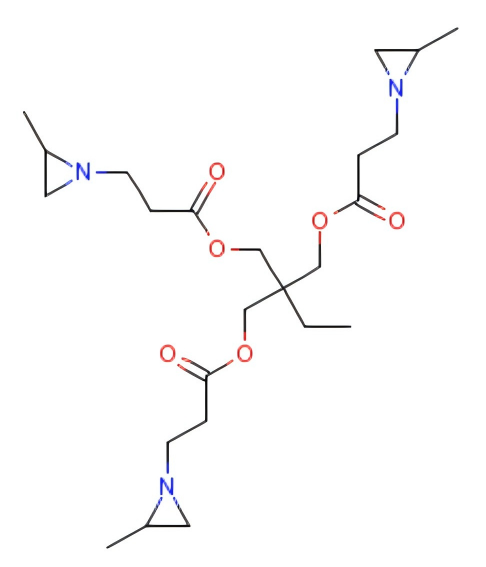
The study used three waterborne acrylic emulsions with different minimum film-forming temperatures (MFFT) — A1, B1 and C1 — and added an aziridine crosslinker.
Table 1 Basic properties of the three waterborne acrylic emulsions
| Emulsion | Solids / % | MFFT/℃ | pH | Particle size / μm |
|---|---|---|---|---|
| A1 | 45~47 | 25 | 7~9 | 0.12 |
| B1 | 46~48 | 10 | 8~9 | 0.1 |
| C1 | 46~48 | 12 | 8~9 | 0.12 |
The crosslinker was added at 0%, 0.5%, 1%, 1.5%, 2%, 2.5% and 3% of the solid resin weight, and the change in each film property was then tested.
The results show that an aziridine crosslinker does not improve every property. It has clear strengths and clear limits.
✅ Strength 1: Blocking resistance rises sharply (the standout benefit)
Waterborne acrylic coatings tend to re-tack in summer, a serious problem for wood lacquers. After the crosslinker was added, blocking resistance improved markedly:
At 1% addition, the two A1 coated panels did not block at all.
At 3% addition, B1 and C1 also separated on their own.
Conclusion: The crosslinker overcomes the poor blocking resistance of waterborne acrylic coatings.
✅ Strength 2: Alcohol resistance improves markedly
Alcohol resistance matters on wood surfaces that often come into contact with alcohol.
As the crosslinker level rises, swelling of the film in ethanol falls clearly.
Ethanol rub resistance increases sharply. C1 withstood only 25 rubs with no crosslinker, but stayed intact after 100 rubs at 2.5% addition, with no change in gloss.
❌ Limitation: A negative effect on strong-alkali resistance
One important warning from the experiment:
In 2% sodium hydroxide solution, swelling of all three acrylic films rose as the crosslinker level increased.
Conclusion: Adding the crosslinker lowers strong-alkali resistance. The end use needs careful attention when the formula is designed.
Gloss:
The crosslinker is compatible with the resin and has no effect on gloss.
Hardness:
Crosslinking can raise film hardness and also lifts the glass transition temperature (Tg).
Water resistance:
In a standard water-resistance test, the difference within 48 hours was small. For resins that already had poor water resistance, such as B1 and C1, the crosslinker reduced whitening and flaking after water immersion.
Summary: effect of aziridine crosslinkers on waterborne acrylic wood coatings
| Property tested | Trend as the crosslinker level increases | Key data points (typical resins in this article) | Assessment |
|---|---|---|---|
| Blocking resistance | Marked improvement The force needed to separate the panels drops quickly |
A1: no blocking at 1% addition B1/C1: they separate on their own at 3% addition |
The main gain: it overcomes the re-tack weakness of acrylic coatings |
| Alcohol resistance (ethanol rub) | Marked increase More rubs are endured, and swelling decreases |
C1: only 25 rubs with none added; intact after 100 rubs at 2.5% | Alcohol resistance rises with dosage and is essentially at its best at 2.5% |
| Strong-alkali resistance | Clear decline Swelling increases in 2% NaOH solution |
Swelling of all three resins rises as the dosage increases | A negative effect; avoid strong-alkali service when designing the formula |
| Tensile strength | Rises, then falls, then rises again It fluctuates between 1% and 1.5% |
A1: 7.13 MPa with none added → 9.34 MPa at 3% | Useful when choosing the dosage; the gain is not linear |
| Hardness | Increased | Overall pendulum hardness is higher | Where very high hardness is required, other additives are still needed |
| Gloss | No effect | 60° gloss stays within 120–138 | Good compatibility, with no effect on film appearance |
| Water resistance | Small difference in standard tests; less whitening and flaking for resins with poor water resistance | For resins with poor water resistance (such as B1 and C1), it reduces whitening after immersion | A useful supporting effect |
| Stain resistance | No change | No improvement against vinegar or green-tea stains | Little improvement in stain resistance |
+86-571-85023839
Address: No. 16 Xianqiao Road, Zhongtai Industrial Park, Yuhang District, Hangzhou, Zhejiang, China
Email: sales@volantgroup.com
Website: www.volantgroup.com


 CN